


You return to your place of residence after a long day at the office where you were supposed to rest and relax. However, all your plans fall apart once you are hit with a wave of odour that reminds you either of wet dog fur or a litter box that has not been cleaned for a couple of days. Regrettably, this is the common problem of many Australians who keep pets.
However, why are these odours so persistent and hard to deal with? Let’s analyse what happens inside your nasal passages to see how you can bid farewell to bad smells once and for all.
Your Sense of Smell and Your Brain
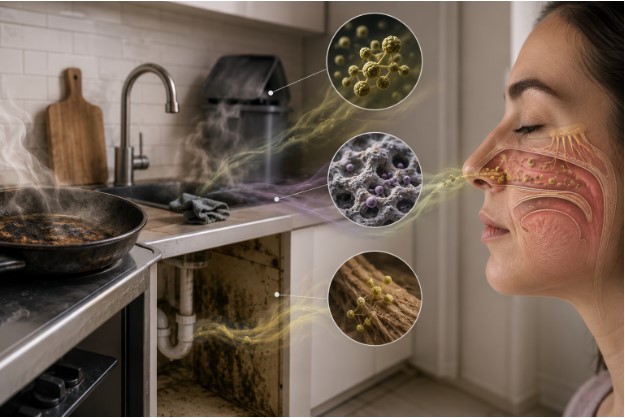
To begin with, one needs to explore the functioning of the olfactory system. Once your pet leaves its odour mark, it releases microscopic particles into the air. Once you inhale them, they get inside your nasal passage and attach to its receptors.
This way, odour particles send electrical impulses directly to the olfactory bulb that is located in the brain. In turn, the olfactory bulb is intricately connected with the amygdala and hippocampus. Thus, odours immediately cause an emotional response and evoke memories. For instance, the smell of a beloved childhood dog will make you smile, whereas the scent of mess will instantly increase your irritation level.
Molecular Structure of Odour Particles
However, not all smells are the same – some odours are heavier and more difficult to eliminate. Uric acid, which is the component of urine in cats and dogs, is the most persistent and difficult odour to handle.
Indeed, when your pet creates a mess, the smell particles of the urine evaporate. However, uric acid particles remain attached to the carpet fibres. In addition, this smell is water-insoluble, which means that you cannot wash it with regular soap and water. If humidity increases in your place of residence, these particles start emitting the smell of ammonia once again.
How to Eliminate Odours Based on Scientific Principles
Since standard cleaning routines do not work for the elimination of such odours, it is necessary to rely on science to deodorise your place of residence.
Neutralisation
In this case, the best strategy would be biological neutralisation of uric acid crystals. Indeed, an enzymatic cleaner contains special bacteria that eliminate the molecules causing the odour. Also, activated charcoal and baking soda are great neutralisers since they absorb odours.
Oxidation
In some cases, it is required to change the molecular structure of odours – this process is called oxidation. Hydrogen peroxide perfectly breaks double bonds of molecules causing odour. Ozone generators are highly effective in eliminating odours throughout the whole room; however, they need to be used with caution since ozone is extremely toxic for humans and animals.
Encapsulation
In some cases, it is necessary to find a quick solution that allows you to neutralise the smell temporarily until you find the time to conduct a thorough cleaning. For this purpose, you may use encapsulating sprays – they wrap odour particles with special chemicals that prevent the bonding with receptors in your nasal passages.
Ventilation and Air Filtration
The most important thing here is the dilution of odour molecules with air. To this end, you may try creating cross-ventilation by opening your windows to release the smelly air outside your house. Alternatively, you may install an air purifier with an activated carbon filter to absorb all odours and HEPA filter to catch dander and fur particles.
Conquer Household Odours
You don’t need to surrender to nasty smells just because there are pets in the house. With sufficient knowledge about the sources of those odours and mechanisms of their functioning, one can easily eliminate them. Try enzymatic cleaners along with installing air filters and enjoy the comfort of a fresh household. Are you aware of other methods to eliminate bad smells?